Our ignition lead testing laboratory
The SENTECH laboratory can carry out all tests required by ISO 3808, ISO 6856, SAE J2031 and SAE J2032, as well as other tests agreed with customers. Its test stations measure resistance, capacitance, terminal pull-off force, insulation resistance up to 5 kV and high-voltage strength up to 120 kV. Thermal chambers cover +300 °C to −50 °C for ageing and thermal shock tests.
Our laboratory is equipped with modern measuring instruments. We can carry out all the tests required by ISO 3808, ISO 6856, SAE J2031 and SAE J2032, as well as any other tests agreed with the customer.
The laboratory allows us to monitor the quality of our products and to compare them with competitors' products. The individual test stations are briefly described below. The descriptions do not cover the full test methodology; they only present the most important measurements made when testing ignition leads.
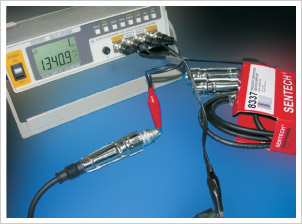
Resistance measuring station
The station is equipped with a modern digital meter for measuring resistance. High-quality Kelvin leads ensure very high measuring accuracy.
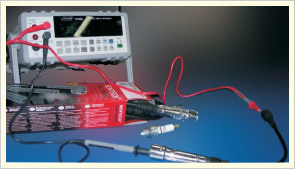
Capacitance and inductance measuring station
The station is equipped with a modern digital meter for measuring capacitance and inductance. Capacitance can also be compared in water, brine or other required liquids.
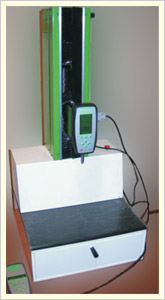
Terminal pull-off force station (quality of the terminal-to-cable joint)
The station is equipped with a modern digital force gauge for measuring the force needed to pull the metal terminal off the cable. The measurement shows the quality of the joint between terminal and cable, so we can determine whether the terminal could come off during use, especially when the leads are being removed.
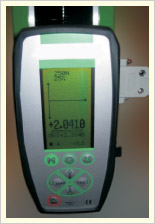
Terminal fitting and removal force station
The station is equipped with a modern digital force gauge for measuring the force needed to pull the metal terminal off. The measurement shows whether the metal terminal will be easy to fit onto the spark plug, distributor or coil, and at the same time whether the connection is strong enough to work properly. Too tight a connection can tear the terminal off the cable when the leads are removed.
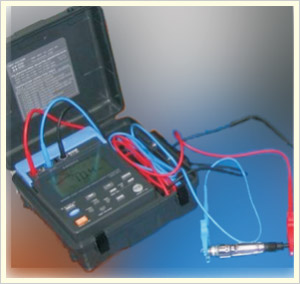
Portable insulation resistance station
The station is equipped with a modern digital meter for testing insulation resistance with DC voltage of up to 5 kV. This test shows how insulation resistance behaves at different voltages. The change in resistance over time at various test voltages allows the quality of the insulation to be assessed very quickly. The measurements are used mainly for comparison, to assess the quality of deliveries and of competitors' leads.
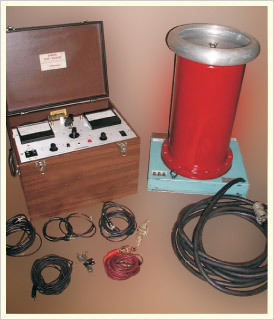
High-voltage test station
The station is equipped with a modern AC high-voltage tester of up to 120 kV. It allows all high-voltage tests of leads and insulators to be carried out in line with the standards. Corona tests at a set voltage show how the leads withstand voltage over time. Another test determines the insulation breakdown voltage. All tests can be carried out on new parts or on parts aged in the thermal chamber.
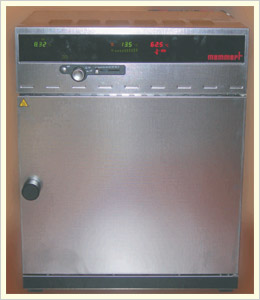
Thermal chamber
A modern thermal chamber for testing cable and other parts at temperatures up to +300 °C. A matching low-temperature chamber down to −50 °C allows thermal shock testing.
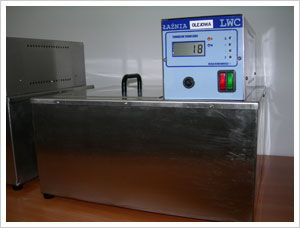
Fluid resistance test stations
The station is equipped with modern thermostatic baths, which allow the leads and their components to be tested for resistance to all kinds of fluids, such as water, brine, oil, coolant and any other liquids required by customers.
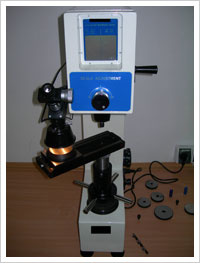
Hardness testing station
The station can measure hardness using the Vickers, Brinell and Rockwell methods. This allows us to check the quality of the metal components of ignition leads and of the tools used to make them. Measuring hardness by different methods across a wide range of scales lets us check the properties of various metals, from soft copper to hardened and tempered steels. The hardness tester provides digital measurement with optical inspection.
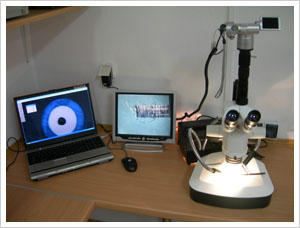
Microscope inspection station
The microscope station allows any damage – such as cracks or insulation breakdown points – to be examined at high magnification. State-of-the-art software enables optical analysis and all kinds of measurements, including length, angle, area, coaxiality, roundness and many others. Advanced stereoscopic analysis and 3D imaging are also available for further examination.