Ignition lead breakdown after replacement
Insulation breakdown on new ignition leads is caused by abnormally high voltage in the secondary circuit. The three main causes are too large a spark plug gap, an open circuit due to mismatched terminals (e.g. M4 vs DIN or barrel vs threaded), and a faulty ignition coil or module. Oscilloscope patterns show how mismatched connections reduce spark energy and can stop the coil discharging.
Ignition system faults are most often caused by damaged spark plugs, high-voltage leads, the coil, the distributor or the Hall sensor.
When diagnosing ignition problems, you start with the most accessible components – the spark plugs and ignition leads. But what if insulation breakdown (arcing) occurs after the ignition leads have been replaced with new ones? There are several possible causes. First of all, breakdown on new ignition leads is caused by an abnormally high voltage in the secondary circuit: ignition coil – ignition leads – spark plug.
Where does too high a voltage in the ignition circuit come from?
There are three reasons for excessive voltage:
- too large a spark plug gap,
- an open circuit (gap) in the high-voltage lead,
- a faulty ignition coil or ignition module.
Too large a spark plug gap
The gap between the spark plug electrodes determines the voltage needed for the spark to jump. The larger the gap, the higher the voltage needed. Always remember to set the correct electrode gap. A common mistake when replacing spark plugs is not checking the gap. Unfortunately, spark plug manufacturers do not set the exact gap for a particular engine – this must be done before fitting the plugs.
Too large a gap forces the coil to generate a higher voltage, which puts more load on the coil and the whole ignition system and therefore increases the risk of damage to the coil or module, which overheat in operation.
Remember too that running an engine on gas instead of petrol increases the voltage needed for the spark to jump. A gas-air mixture in the cylinder needs about 10–30% more voltage. In this case, reducing the spark plug gap is recommended.
Open circuit in the high-voltage lead
This problem arises mainly because leads are used with terminals that differ from those needed in a particular car. Unfortunately, even vehicle manufacturers' catalogues do not cover every variant found in a given model. As a result, a lead set may be chosen from the catalogue that matches the car but does not have the correct metal terminal to ensure a proper electrical connection – for example, a set with DIN terminals is fitted to a distributor cap with M4 connections, or vice versa. This creates a gap in the high-voltage circuit (at the ignition leads), which causes excessively high voltage and damages the ignition leads and, later, the coil and ignition module.
A similar problem can occur where the ignition leads connect to the spark plugs. The most common mistake here is fitting leads with a barrel (snap-on) terminal to a spark plug with an M4 threaded terminal. Ignition lead sets should include the appropriate adaptors.
So even though the new leads are in perfect working order, choosing the wrong leads for a particular model can create an open circuit in the high-voltage circuit after fitting.
Faulty ignition coil or module
A faulty coil or ignition module is a common cause of excessive voltage. A faulty ignition coil can still generate high voltage, but the energy stored in it cannot sustain the discharge long enough to ignite the mixture in the cylinder. This shows up as insulation breakdown on the ignition leads.
It is also worth mentioning that what we see in the dark as "breakdown" very often is not. It may be surface discharges on the leads caused by ionisation of the air as high-voltage current flows through them. This mostly affects leads with a "wire-wound" core.
Sometimes a poor earth connection on part of the coil or module causes an excessively high voltage pulse to be generated. An open circuit in the coil's secondary winding produces exactly the same symptoms as the open circuit in the high-voltage lead described above. It also happens that the old ignition leads have quite a high electrical resistance, which masks the effects of the system generating too high a voltage. Unfortunately, this only creates the illusion that the ignition system is working properly.
Interpreting the oscilloscope patterns
The oscilloscope patterns below show the high-voltage waveform with various faults and illustrate some of the problems described here. See also: how to read an ignition oscilloscope pattern.
Patterns 1 and 2 show the effect of an incorrect connection at the spark plug. Depending on the size of the gap in the connection, two different and quite characteristic patterns can be seen. The most interesting section lies between points A' and D'.
Pattern 1
A gap in the circuit (between the lead terminal and the spark plug terminal) shows up as discharges visible on the oscilloscope pattern between points B' and C'.
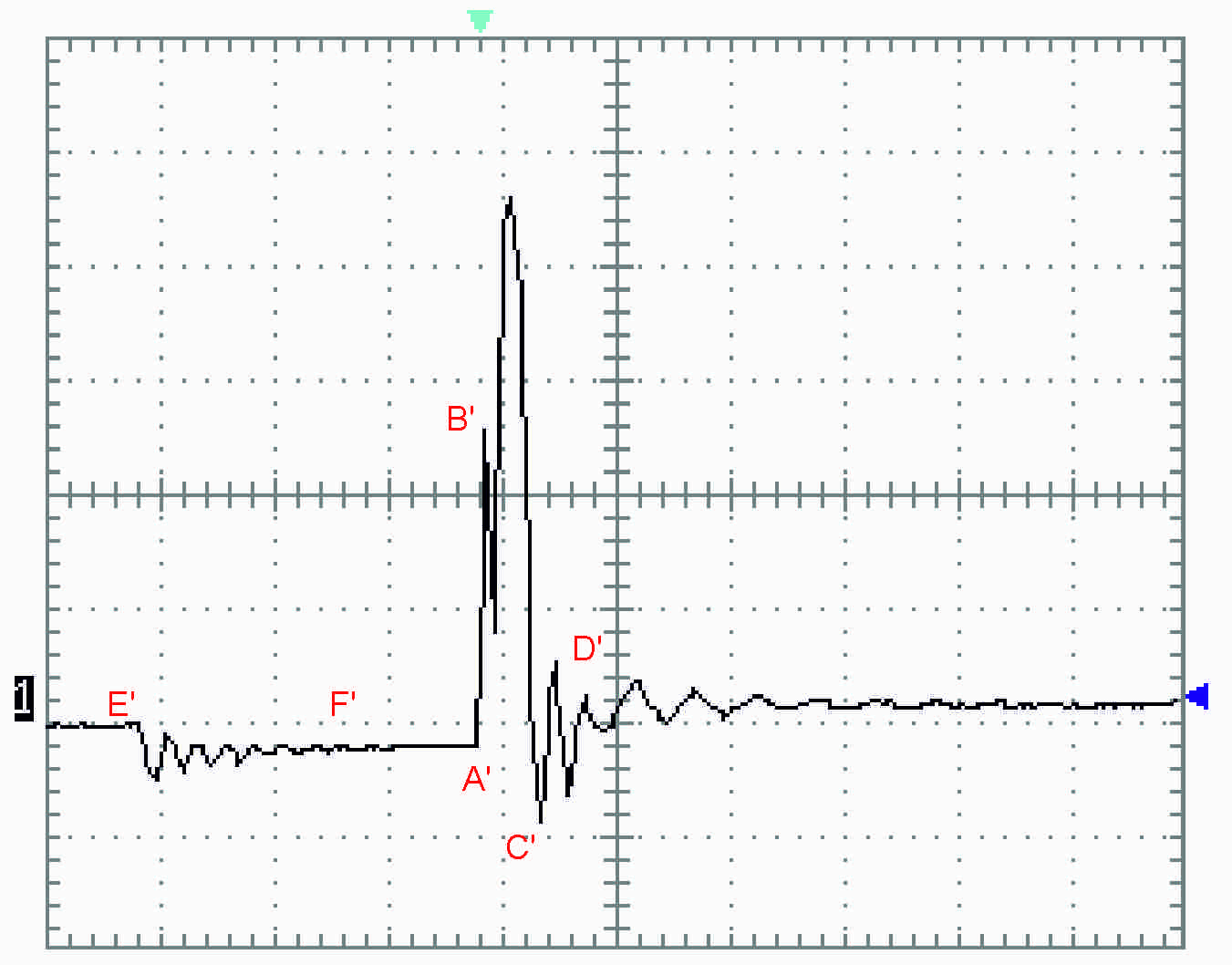
Pattern 1 shows a small gap between the ignition lead terminal and the spark plug connection terminal. A whole series of small discharges can be seen between points B' and C'. The spark jumps between the lead terminal and the spark plug terminal first, and only then across the spark plug electrodes. There is no time for the arc and its current phase to stabilise. The current flowing in the discharges is practically zero, so the spark has very little energy: it consists of many successive very low-energy discharges. Under the increased pressure in the cylinder, the spark may fail to jump at the plug, and breakdown from the ignition leads to earth may occur instead.
Pattern 2
A large gap in the circuit, in the same place as in the previous case. Here there are two discharges, also visible on the oscilloscope pattern between points B' and C'.
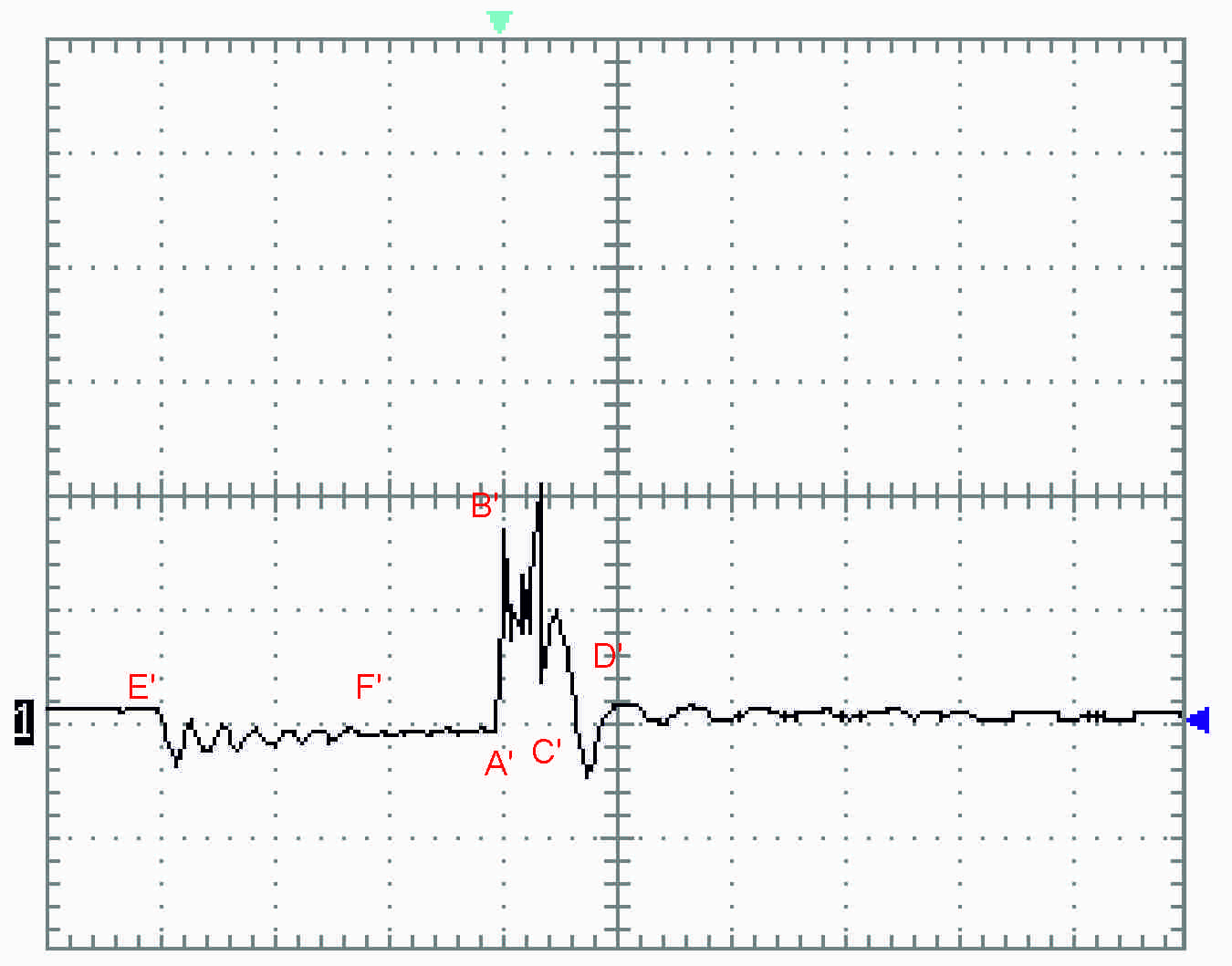
Pattern 2 shows a larger gap in the connection between the ignition lead terminal and the spark plug connection terminal. Two larger discharges can be seen between points B' and C'. The spark jumps between the lead terminal and the spark plug terminal, and only then across the spark plug electrodes. There is practically no current phase, so the ignition energy is low.
It is worth stressing that what we call a "good spark" is often nothing of the sort. We tend to assume that a bright blue spark is much better than a red one. In terms of energy, however, a red spark carries a high current and is a high-energy spark capable of igniting the mixture. A blue spark indicates high voltage but will not always ignite the mixture in the cylinder. Pattern 2 is typical of almost all cases of a poor connection between the distributor and the terminal of the lead running to the spark plug.
Pattern 3
A short current phase between points B' and C' does not allow the coil to discharge. This results from incorrectly matched ignition lead connections and can damage the ignition coil.
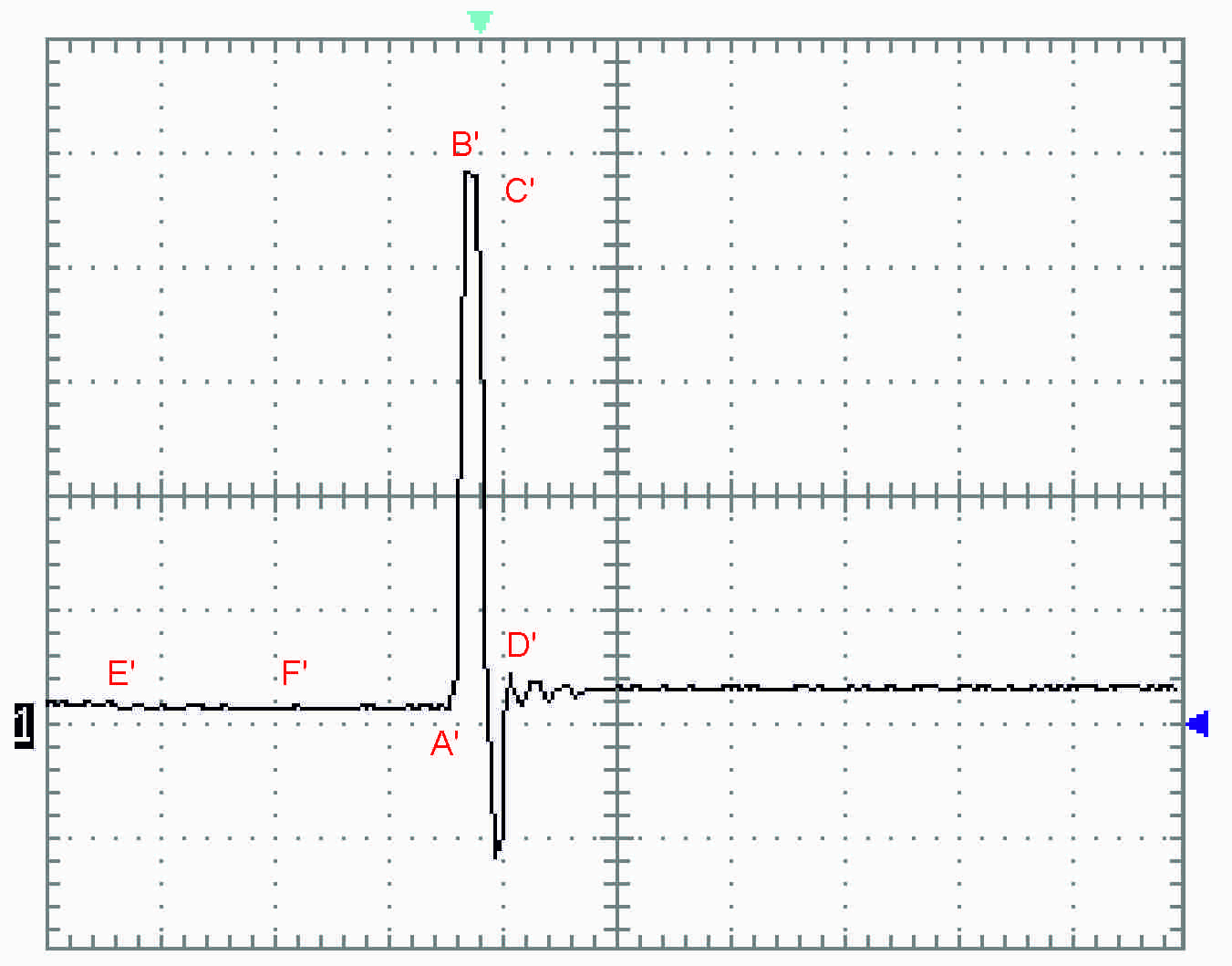
Pattern 3 shows the most extreme case of mismatched connections on both the distributor and the spark plug side. The very short current phase between points B' and C' does not allow the coil to discharge. This can be seen between points E' and F': there is clearly no characteristic decaying sine wave, so the coil has not discharged. This condition can lead to breakdown on the ignition leads and to overheating and, ultimately, failure of the ignition coil.
Summary: what to check
If, after fitting new ignition leads, you find that they are arcing, and refitting the old leads makes the engine run more or less properly (and the spark plugs have not been changed in the meantime):
- Check that the connection terminals on the coil and distributor side and on the spark plug side are correctly matched.
- Check the condition of the spark plugs and the electrode gap (on LPG engines the gap should be reduced by 10–30% of the nominal value).
- With leads other than copper core leads, use spark plugs without internal resistors.
- Check the condition and cleanliness of the connectors that stay on the vehicle (clean corroded connectors and replace damaged ones – sometimes this means replacing the whole component, e.g. the ignition coil).
- Check the earth connection between the DIS module and the coil.
- Replace the coil, module or DIS unit with an undamaged one.
High-quality, fully working ignition leads mercilessly expose every fault in the ignition system and – ironically – can themselves be damaged as a result. In one known case, replacing the ignition leads made the clutch start to slip. How is that possible? After the replacement, engine power increased so much that a previously unnoticed slipping clutch suddenly became obvious. This case shows how much power an engine loses with a faulty ignition system, and how restoring the system can uncover a wave of "hidden" faults that went unnoticed while the drivetrain was running below par.
This article is based on information from GG Profits and is its property. Copying or adapting the text and graphs without the consent of GG Profits Sp. z o.o. is prohibited.